



Aluminium Honeycomb Cores
Understanding the Heart of Honeycomb Panels: Different Core Types Explained
 By
nexcomb
October 12, 2026
By
nexcomb
October 12, 2026
A honeycomb panel can look deceptively simple. Two skins, a cellular core, and a finished panel. But the real engineering story sits inside that middle layer.
The core influences stiffness, weight, thermal behaviour, moisture resistance and, depending on its composition, fire performance. That is why honeycomb panel core types matter before comparing panels only by thickness or weight.
What Is Honeycomb Panel Core?
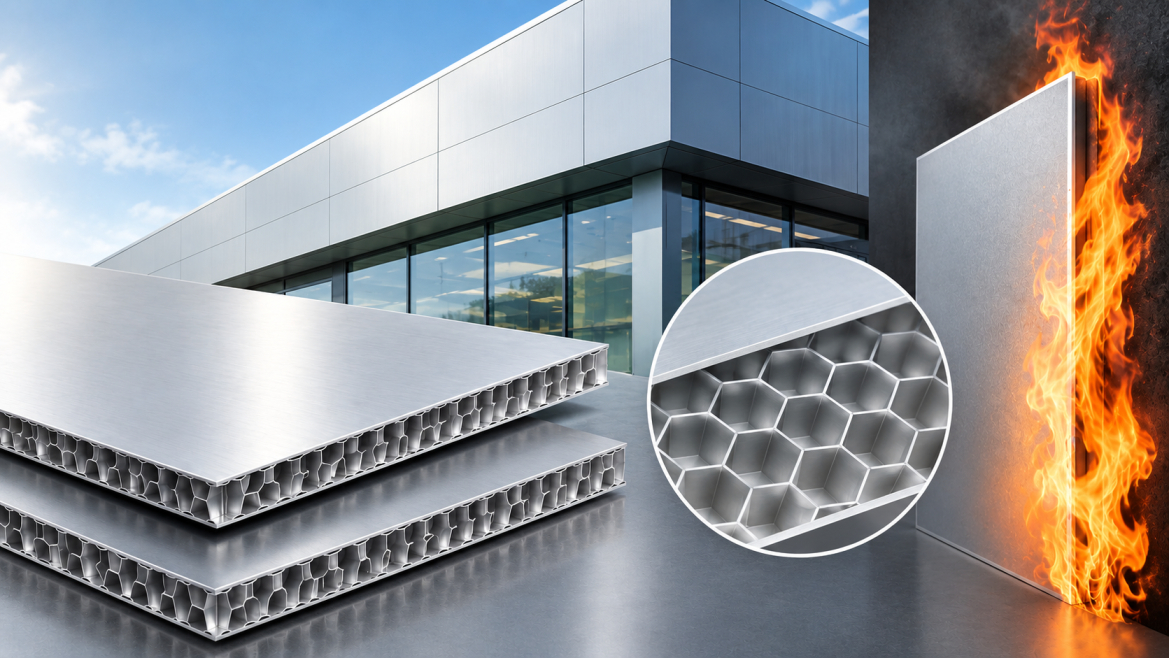
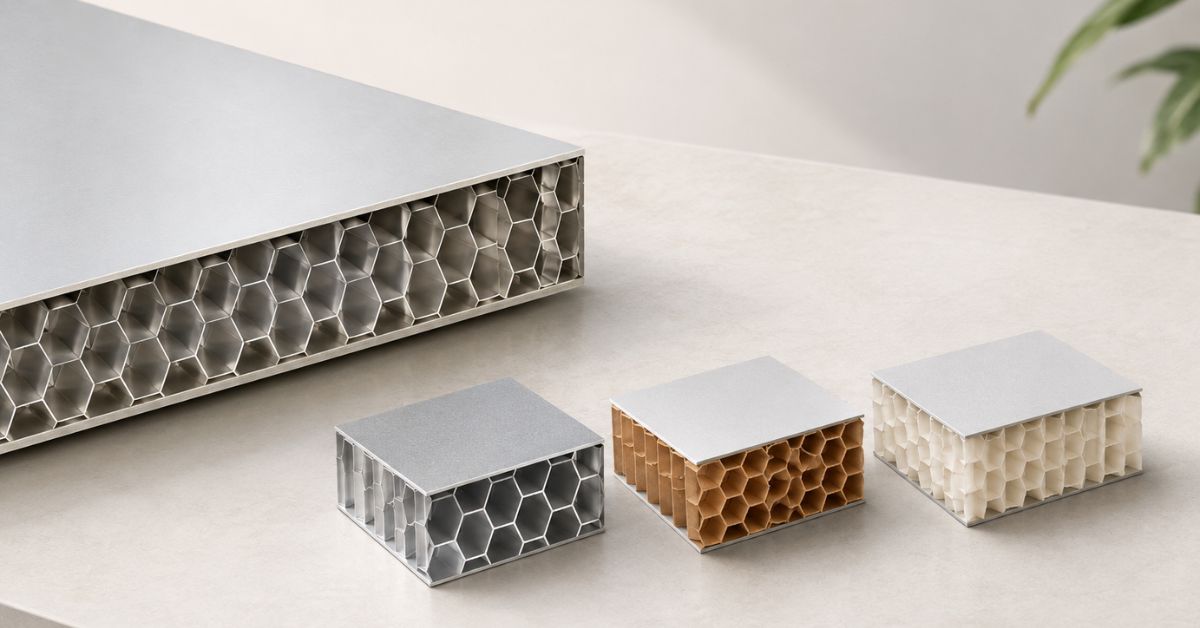
Think of the core as the structural middle of a sandwich. The facing sheets carry much of the tensile and compressive load, while the cellular core keeps them separated and helps the panel resist bending and shear.
The geometry is clever. A hexagonal cell uses relatively little material while creating a deeper structural section. In simple terms, increasing the distance between the skins can increase stiffness without filling the entire space with solid material.
This is why honeycomb panel core types cannot be treated as interchangeable. The material used for the cells changes how the panel behaves.
For our Nexcomb panels, we manufacture the honeycomb core in-house as Nexcore. It uses AA3003, H18 grade aluminium, with cell sizes of 2, 3, 4, 6, 10, 14 and 19 mm. The core can be produced across a thickness range of 3 to 100 mm, depending on the panel configuration.
Types of Honeycomb Panel Core Materials
Aluminium Honeycomb Core
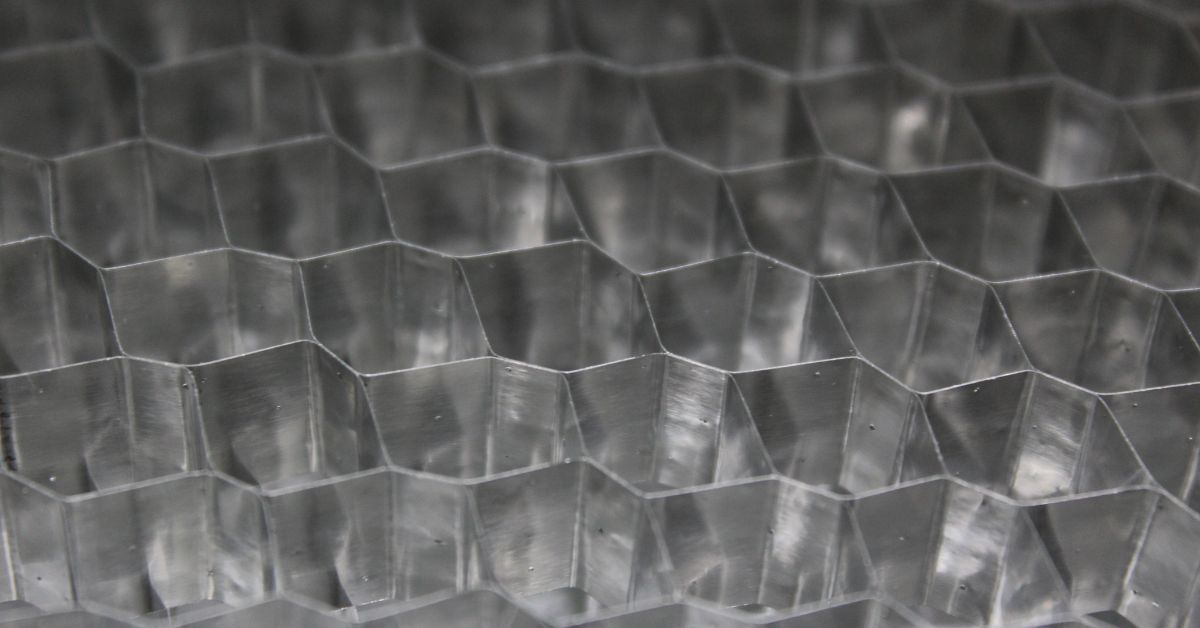
An aluminium honeycomb core is made from thin aluminium foil formed into a cellular structure. Its main attraction is the combination of low mass, rigidity and durability.
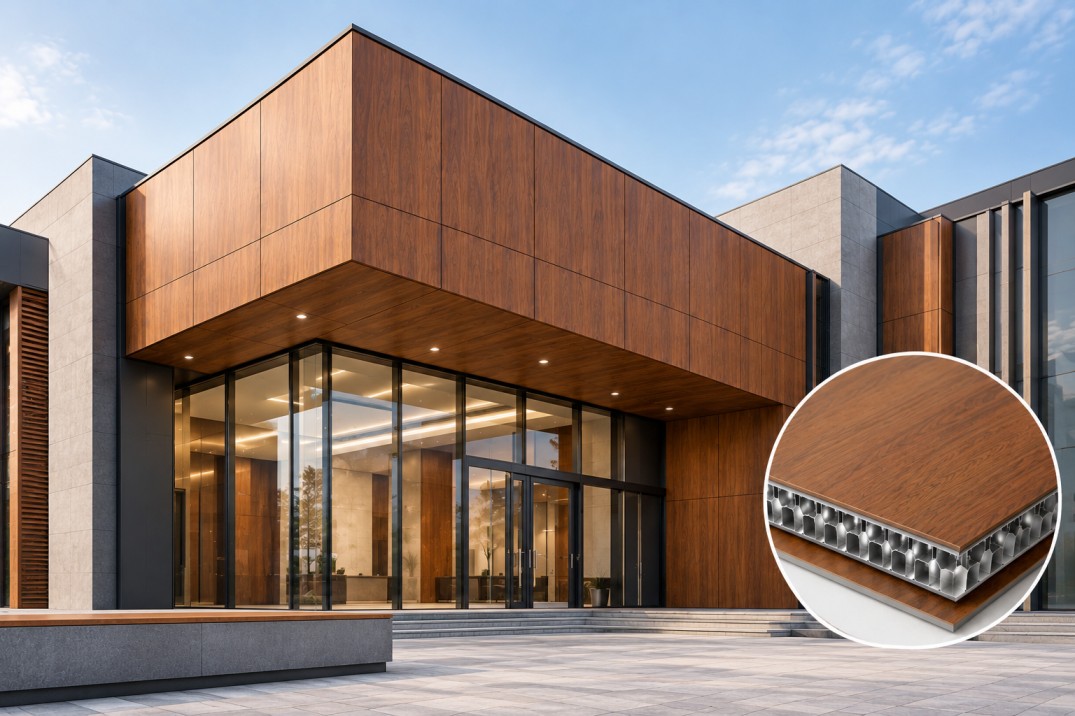
For façade and architectural panels, this construction can be particularly useful where large panel dimensions and reduced dead load matter. Our Nexcore uses AA3003 H18 aluminium alloy and is manufactured in-house. We also test the core and finished panel through methods covering shear, compression, tensile, flexural and peel properties.
This makes the core more than a lightweight filler. It is an engineered structural component of the panel.
Also Read: Aluminium Honeycomb Panels That Deliver Strength and Fire Resistance
Nomex Honeycomb Core
This core is generally made from aramid paper that is treated with a resin. It is widely associated with applications where low weight, high stiffness and specific fire or smoke performance are important.
Its behaviour is different from aluminium because the core is non-metallic. Depending on the grade and system, it can be used in aerospace, transport and other lightweight structures.
However, the phrase Nomex honeycomb core alone does not define a panel’s complete fire or structural performance. The finished sandwich construction, facing materials, adhesives, thickness and test classification all matter.
Paper Honeycomb Core
A paper honeycomb core is typically produced from kraft or similar paper formed into cells and bonded into a block or panel. It is valued mainly for its low weight and cost effectiveness.
That makes this core useful in applications where extreme structural performance is not the primary requirement. Furniture, packaging, partitions and interior constructions are common areas where paper-based cellular cores may be considered.
But moisture, fire performance and durability depend heavily on the paper grade, treatments and complete panel construction. So, a paper honeycomb core should not be judged simply by its cell pattern.
What Is Honeycomb Cell Size and Density?
Cell size refers to the dimension of each individual honeycomb opening, usually measured across the cell. In practice, smaller cells mean more cells within the same area, while larger cells reduce the number of cell walls.
Core density is different. It describes how much the core weighs for a given volume, usually expressed in kg/m³.
Together, cell size and density influence stiffness, weight and load behaviour. This is where honeycomb panel core types become more nuanced. Two panels can use the same core material but behave differently because their cell size, foil or paper thickness, density and overall panel thickness are different.
Our Nexcore range illustrates this principle with multiple cell sizes and core thicknesses rather than relying on one standard geometry.
Honeycomb Panel Core Types Compared
| Core type | Key characteristic | Typical advantage | Important consideration |
|---|---|---|---|
| Aluminium honeycomb core | Metallic cellular structure | High rigidity, low weight and durability | Cost and fabrication requirements |
| Nomex honeycomb core | Aramid paper cellular structure | Lightweight with useful fire and smoke characteristics in specified grades | Performance varies by grade and system |
| Paper honeycomb core | Paper-based cellular structure | Very light and economical | Moisture, durability and fire performance require careful specification |
The table shows why honeycomb panel core types should be selected according to the application rather than by a single headline property.
An aluminium honeycomb core is particularly suited to applications where structural efficiency and long-term durability are important. A Nomex honeycomb core may be selected when very low weight and specific transport or aerospace requirements take priority. A paper honeycomb core can make sense when economical lightweight construction is the main objective.
There is no universal winner. The specification decides.
Which Core Type Is Used Where?
The application usually narrows the choice quickly.
For architectural façades, ceilings, cleanrooms and mobility applications, our Nexcomb system uses an aluminium honeycomb core because the panel needs a useful balance of rigidity, weight and durability. Our 10 mm Nexcomb configuration, for example, is listed at 5.2 kg/m² in our product comparison data.
A Nomex honeycomb core is more commonly associated with specialist lightweight structures, particularly where its aramid construction and specified fire or smoke characteristics are useful.
A paper honeycomb core is generally more appropriate for lighter-duty interior or temporary constructions, where cost and low weight matter more.
This distinction is important because honeycomb panel core types are not simply different versions of the same product. They represent different engineering compromises.
For our applications, Nexcore also provides a fully recyclable aluminium-based core. It is manufactured in-house, giving us greater control over core production and its integration into the finished panel.
Also Read: Aluminium Honeycomb Core Manufacturing Process for Nexcomb
The Core Is Where the Difference Begins
A honeycomb panel is only as good as the relationship between its skins, core, adhesive and manufacturing process. The cellular geometry creates the efficiency, but the core material determines much of how that efficiency behaves in service.
That is why honeycomb panel core types deserve more attention than they usually get.
An aluminium honeycomb core brings metallic durability and structural efficiency. A Nomex honeycomb core serves specialist lightweight applications where aramid characteristics are useful. A paper honeycomb core offers an economical route to lightweight construction.
Ultimately, honeycomb panel core types should be selected according to the performance requirements of the application, not simply by the material name.
Contact us at info@nexcomb.com or call 1800 102 0407 (Toll-Free) to connect with our expert panel consultants.
FAQs
What is the strongest honeycomb core material?
There is no single answer because core strength depends on material grade, density, cell size, foil or sheet thickness, panel thickness and loading direction. An aluminium honeycomb core can provide high compressive and shear performance, but the finished panel must be evaluated as a complete sandwich structure.
What is honeycomb cell size measured in?
Honeycomb cell size is generally specified by the dimension across an individual cell. It is commonly stated in millimetres. Our Nexcore is available in 2, 3, 4, 6, 10, 14 and 19 mm cell sizes.
What’s the difference between aluminium and Nomex honeycomb core?
The main difference is the core material. Aluminium uses aluminium foil, while Nomex uses aramid paper treated with resin. This difference affects weight, stiffness, durability, fire behaviour and the applications for which each construction is suitable.
How does core density affect panel strength?
Increasing core density generally means more material within the cellular structure, which can improve certain strength and stiffness properties. But density should not be considered in isolation. Cell geometry, core thickness, skin thickness, adhesive bonding and loading conditions all influence the final performance of the panel.