



Aluminium Honeycomb Panels
Aluminium Honeycomb Panels That Deliver Strength and Fire Resistance
 By
nexcomb
September 26, 2026
By
nexcomb
September 26, 2026
When a building material has to be strong, lightweight and fire safe at the same time, the usual answer is to compromise somewhere. More strength often means more weight. More material can mean more dead load. And fire performance can introduce another layer of specification altogether.
Honeycomb construction takes a rather different route. By combining aluminium facing skins with a lightweight hexagonal core, aluminium honeycomb panels achieve an impressive strength-to-weight ratio without relying on a solid mass of material.
The principle is not new. Nature got there first with the beehive. The clever bit is translating that geometry into a precisely engineered building material.
What Are Aluminium Honeycomb Panels?
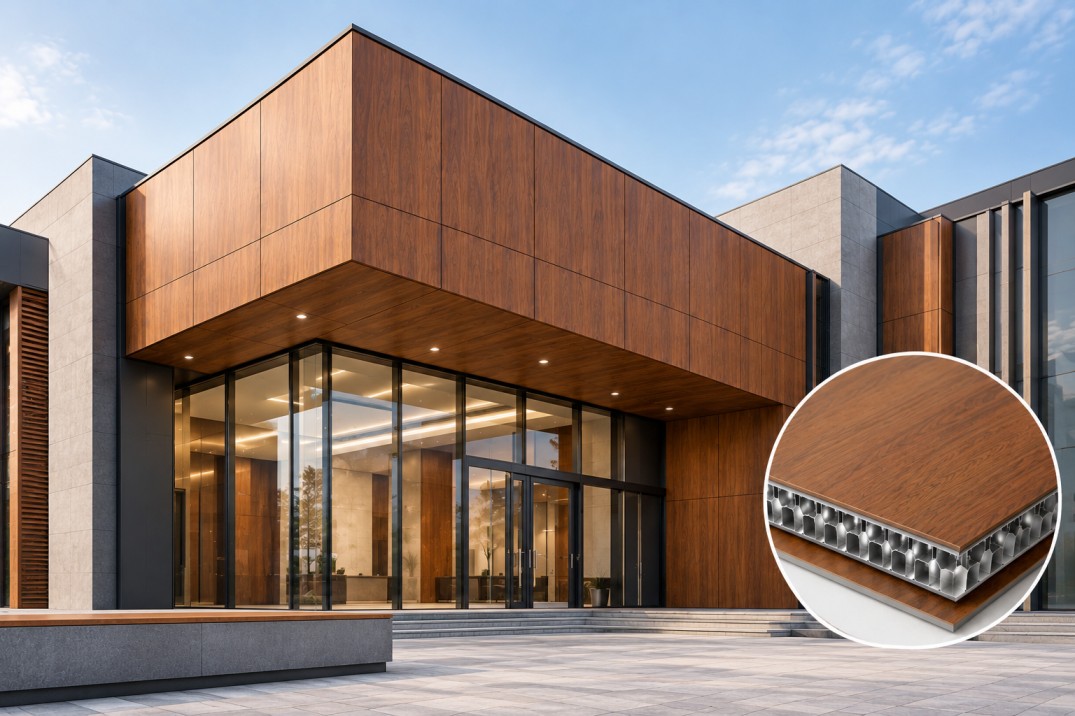
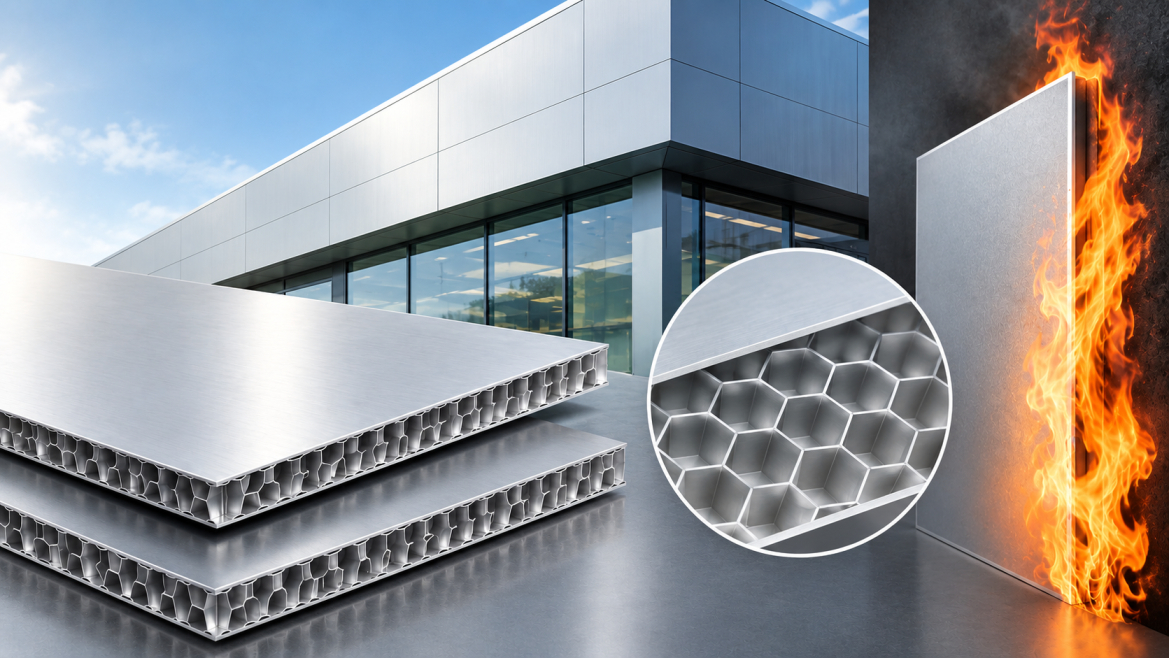
At their simplest, these are sandwich constructions made from aluminium skins bonded to an aluminium honeycomb core. The core consists of interconnected hexagonal cells, creating a lightweight structure that supports the facing skins while contributing to the overall stiffness of the panel.
The geometry is what makes the concept so effective. The skins act somewhat like the flanges of an I-beam, while the honeycomb core performs a role similar to its web. One facing skin primarily takes compression and the other tension, while the core transfers shear and keeps the skins apart.
This creates a unified panel with considerable bending and torsional rigidity.
At Aludecor, we take this principle further through Nexcomb, powered by our in-house Nexcore honeycomb core manufacturing facility. Nexcore is manufactured from AA3003, H18 grade aluminium alloy, with available cell sizes of 2, 3, 4, 6, 10, 14 and 19 mm.
That level of control matters because honeycomb is not simply about having hexagonal cells. Cell size, foil thickness, skin thickness and overall panel thickness all influence the final performance.
How Aluminium Honeycomb Panels Achieve High Strength
There is an interesting engineering trick at work here. Instead of making a panel solid, material is positioned where it can contribute most effectively to stiffness.
The hexagonal structure creates countless miniature I-beams. The facing skins carry bending stresses, while the core braces them apart and takes the shear loads. The result is a panel that can achieve substantial rigidity without the mass associated with a solid aluminium section.
For Nexcomb, panel thickness can range from 6 mm to 100 mm, while the top skin thicknesses range from 0.7 mm to 1 mm and bottom skin thicknesses range from 0.5 mm to 1 mm.
There is also considerable flexibility in core geometry. Nexcore is available in multiple cell sizes, allowing the construction to be adapted to different strength and weight requirements.
This is where aluminium honeycomb panels become particularly useful for large-format applications. Lower weight can reduce dead load on the building, while the rigidity of the sandwich construction helps maintain panel flatness and dimensional stability.
And the performance is not merely theoretical. There are various tests conducted for flatwise tensile strength, shear properties, edgewise compressive strength, flatwise compression, delamination strength and flexural properties, using ASTM test methods including C297, C273, C364, C365, C363 and C393.
Also Read: Aluminium Honeycomb Panels The Future of Lightweight, High-Strength Solutions
Fire Performance and Safety Ratings
Fire safety needs precise language. Aluminium is non-combustible, but a finished panel is a composite construction involving skins, core and bonding systems. So, the fire performance of the complete product needs to be considered.
Nexcomb’s documented fire performance is Class A2-s1, d0 as per EN 13501-1. The Nexcomb panels are near non-combustible and the A2 classification meets the sought-after performance criteria for high-rise and high-risk structures.
For fire resistant honeycomb panels, this classification is significant because EN 13501-1 evaluates reaction to fire rather than simply asking whether a material contains aluminium.
The classification A2-s1, d0 indicates a product with a very limited contribution to fire, low smoke production and no flaming droplets under the applicable test classification. It should, however, not be confused with a fire resistance rating such as 30, 60 or 120 minutes.
That distinction becomes important while specifying fire rated honeycomb panels. A reaction-to-fire classification applies to the tested product, whereas fire resistance concerns how an entire building element maintains functions such as integrity or insulation for a specified period.
So, fire resistant honeycomb panels should always be evaluated against their actual test documentation and intended application.
For projects where fire safety is a major consideration, fire rated honeycomb panels offer a route to combining lightweight construction with a documented reaction-to-fire classification.
Applications of Aluminium Honeycomb Panels
The combination of low weight and high rigidity gives aluminium honeycomb panels a fairly broad application range.
1. Facades
Large façades are one of the most natural applications. The lower weight can help minimise dead load, while the stiffness of the construction supports large, visually clean surfaces. Nexcomb also offers panel thickness flexibility from 6 mm to 100 mm and curved applications with radii ranging from 300 mm to 2,000 mm.
Where fire requirements are stringent, fire resistant honeycomb panels can be considered when their documented classification meets the project specification.
2. Transport and Mobility
Weight matters considerably in mobility applications. Lighter panels can contribute to weight optimisation while providing a rigid finished surface.
The relevant fire requirements, of course, depend on the particular vehicle and application. Fire rated honeycomb panels should therefore be selected against the applicable transport standards rather than a generic fire claim.
3. Ceilings and Interiors
Honeycomb construction is also suited to ceilings, partitions and interior wall applications. Aludecor has developed different fixing systems for these applications, including the Zenith-Lock system specifically for ceilings and the Interlock system for partitions and interior wall cladding.
4. Cleanrooms
In cleanrooms, dimensional stability, surface finish and ease of installation can be important considerations alongside structural performance.
Also Read: Redefining Modern Cladding: Composite Honeycomb Panels with Real-Wood Finish
Aluminium Honeycomb Panels vs Traditional ACP and Solid Panels
The easiest way to understand the difference is to look at what each material is trying to achieve. A solid aluminium sheet relies on its mass and thickness. ACP uses aluminium skins around a core. Honeycomb construction takes the sandwich principle further, using a deeper cellular core to create a rigid yet lightweight panel.
Here are how the materials compare across some of the parameters that matter in real-world applications.
| Parameter | Nexcomb Aluminium Honeycomb Panel | Solid Aluminium Sheet | Stone | HPL | ACP |
|---|---|---|---|---|---|
| Weight | Lightweight | Heavy | Heavy | Light | Lightweight |
| Rigidity | High | Low | Low | Low | Medium |
| Surface flatness | High | Low | Low | Low | High |
| Panel size | Large | Small | Small | Small | Large |
| Thermal / sound insulation | Good | Low | Low | Low | Moderate |
| Moisture resistance | Excellent | Excellent | Good | Good | Excellent |
| Installation | Factory-made, fast and easy | On-site, comparatively costly | On-site, comparatively costly | On-site, comparatively costly | Factory-made, fast and easy |
For applications demanding a strong yet lightweight construction, fire resistant honeycomb panels can offer an interesting combination of engineering efficiency and fire performance. And when the specification calls for documented reaction-to-fire performance, fire rated honeycomb panels should be evaluated using the relevant classification and test evidence.
Why Nexcomb Brings More to the Equation
At Aludecor, the differentiator is not just the honeycomb concept. It is the control we have over the manufacturing process.
Nexcomb is powered by Nexcore, our in-house honeycomb core. Aludecor is the only façade product manufacturer with an in-house aluminium honeycomb core manufacturing facility.
The production line is fully automated, with integrated roll forming and glue dispensing. This allows greater consistency in core production, bonding and panel assembly.
The system also offers ready-to-fix panels, exceptional flatness and a range of fixing solutions developed for specific applications.
There is a sustainability argument too. Nexcomb panels are 100% recyclable and contain 30% recycled aluminium. It also gives a comparative carbon figure for a 12 mm Nexcomb panel with 50% recycled aluminium skins: 4 – 7 kg CO₂ e/m², compared with approximately 9 – 11 kg CO₂ e/m² for a 3 mm solid aluminium sheet and 10 – 13 kg CO₂ e/m² for a 4 mm ACP under the stated configurations.
That combination of material efficiency, lightweight construction, recyclability and documented performance is what makes the system worth considering beyond the usual “strong and light” description.
The Strength of Smart Geometry
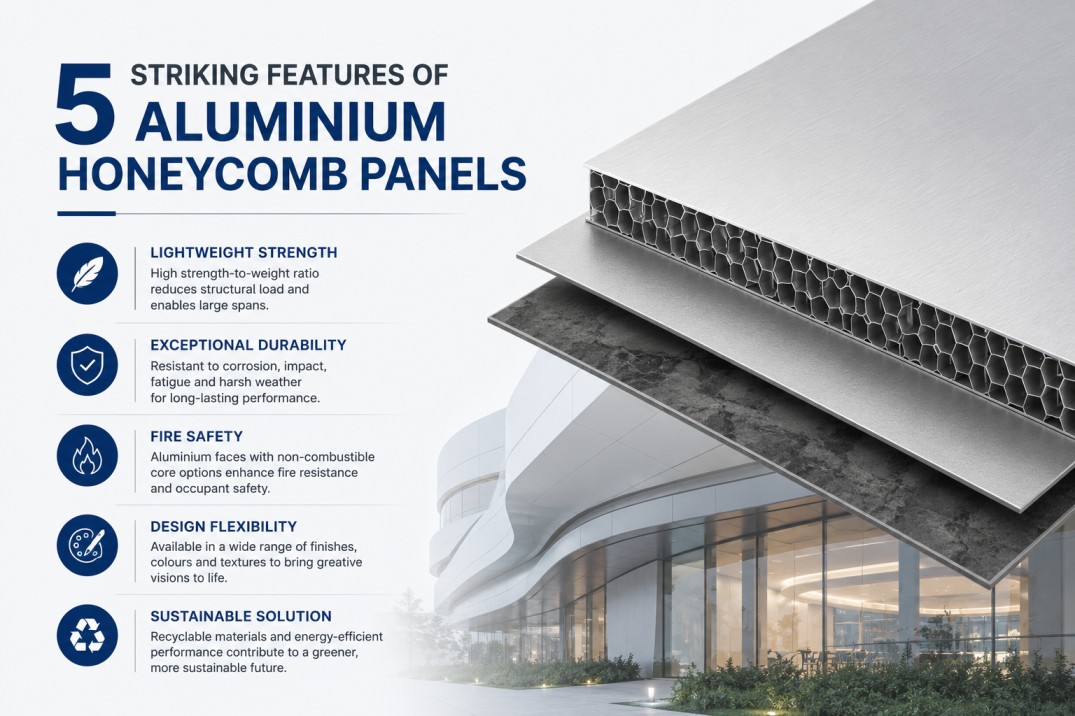
The real appeal of aluminium honeycomb panels lies in an elegant engineering idea: use geometry intelligently, rather than simply adding more material.
The hexagonal core separates and supports the facing skins, producing a rigid sandwich construction with a strong strength-to-weight ratio. Add controlled manufacturing, multiple panel thicknesses, different cell sizes and documented testing, and the proposition becomes considerably more compelling.
Fire performance is equally important. Nexcomb is documented with an A2-s1, d0 classification under EN 13501-1, making its fire performance a defined characteristic rather than an assumption based solely on the use of aluminium.
For demanding façades, ceilings, cleanrooms and mobility applications, that balance of rigidity, weight, precision and fire performance is hard to ignore.
Contact us at info@nexcomb.com or call 1800 102 0407 (Toll-Free) to connect with our expert panel consultants.
FAQs
Are aluminium honeycomb panels fireproof?
“Fireproof” is not generally the most precise way to describe a building product. Nexcomb is documented as near non-combustible and classified A2-s1, d0 under EN 13501-1. This relates to reaction to fire and should not be interpreted as an unlimited guarantee of performance in every fire scenario.
For fire resistant honeycomb panels, the complete panel construction matters, not simply the fact that its core is aluminium.
How much weight can aluminium honeycomb panels support?
There is no universal load-bearing figure. Capacity depends on panel thickness, skin thickness, core geometry, span, support conditions, fixing arrangement and the nature of the applied load.
What fire rating do aluminium honeycomb panels have?
Nexcomb has a documented Class A2-s1, d0 reaction-to-fire classification under EN 13501-1. The classification indicates very limited contribution to fire, low smoke production and no flaming droplets under the applicable classification system.
It is important to distinguish this from a fire resistance rating expressed in minutes. Fire rated honeycomb panels should always be assessed using the specific product’s certification and the requirements of the project.
Are aluminium honeycomb panels suitable for facade cladding?
Yes. Their high rigidity-to-weight ratio, panel thickness flexibility and ability to accommodate large formats make them suitable for façade applications. Nexcomb also offers several fixing systems, with Uni-Lock, M-Lock and Edge-Lock generally used for façade applications.
For façades with stringent fire requirements, fire resistant honeycomb panels can be considered when the documented classification satisfies the project specification. Similarly, fire rated honeycomb panels should be selected based on verified product performance rather than the term “fire rated” alone.
The final selection should take into account wind loads, panel dimensions, support conditions, fixing design, movement requirements and applicable fire regulations.