



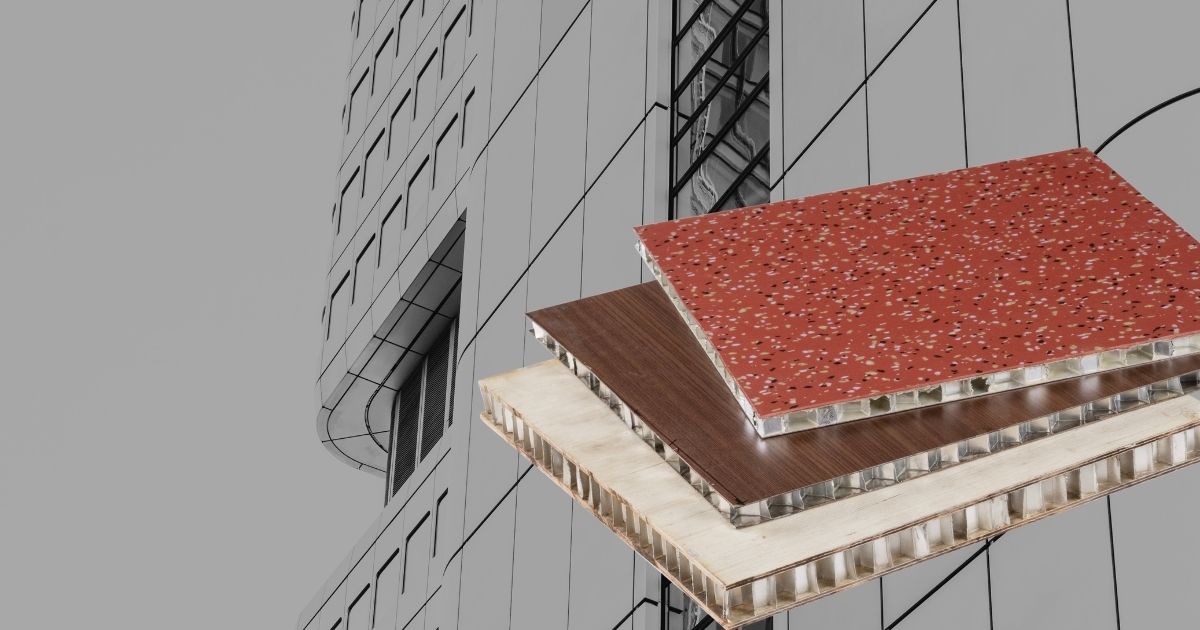
Aluminium Honeycomb Core Manufacturing Process: Precision Engineering for High-Performance Composite Panels
When strength must coexist with extreme lightness, conventional materials begin to look outdated. Solid sheets add weight. ACP adds layers. Stone adds load. But Nexcomb with Aluminium Honeycomb Core changes the structural equation entirely. We engineer Nexcomb aluminium honeycomb panels with our fully automated in house honeycomb core manufacturing facility, making us the only façade product manufacturer in India to produce both the honeycomb core and the finished panel under one integrated ecosystem . That integration matters. It allows tighter tolerances, superior bonding control and measurable structural reliability.
Let us walk you through how Nexcomb is manufactured, what defines its performance, and why it stands structurally ahead of solid sheets, ACP and conventional cladding systems.
The Engineering Logic Behind Nexcomb
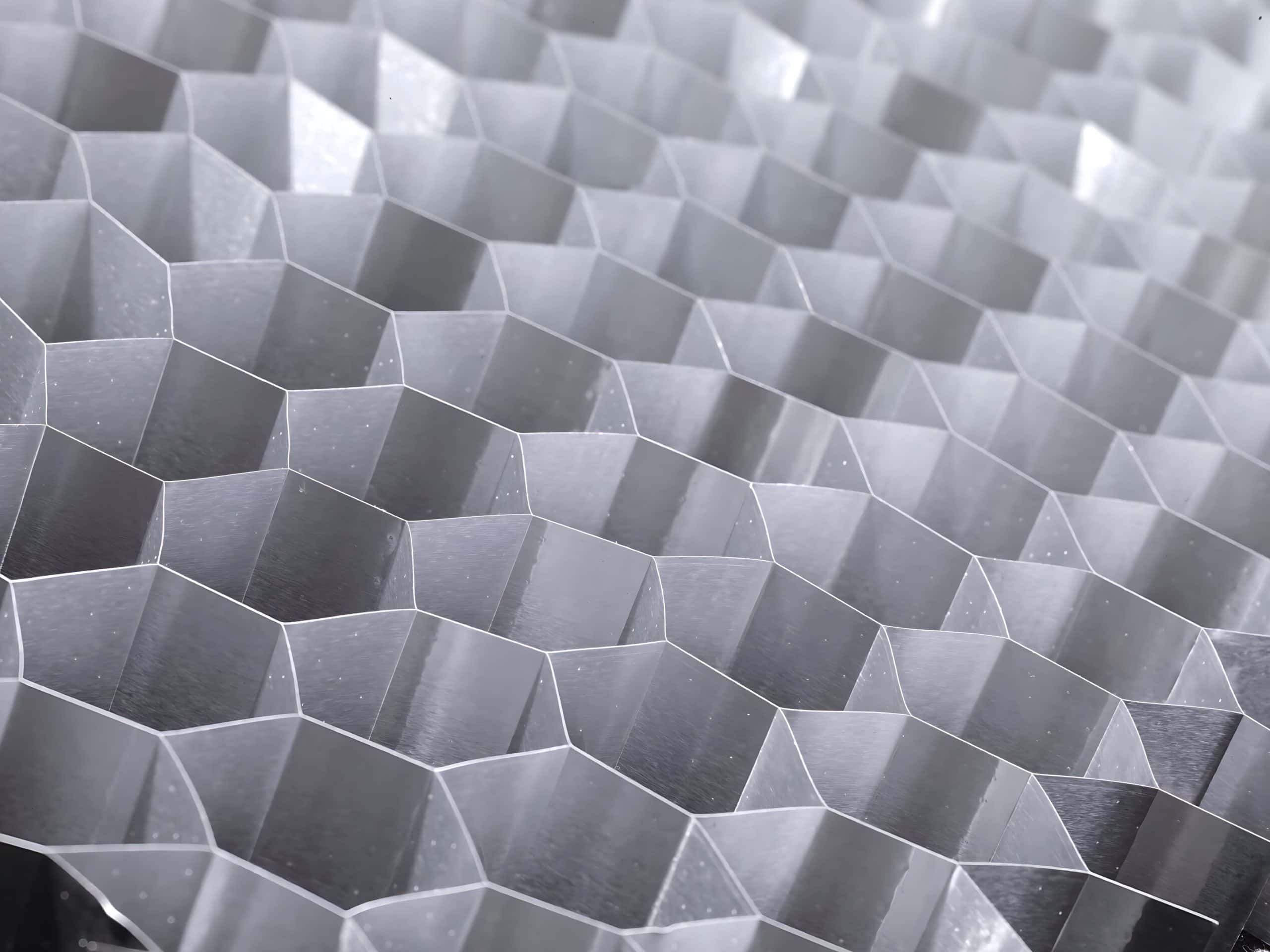
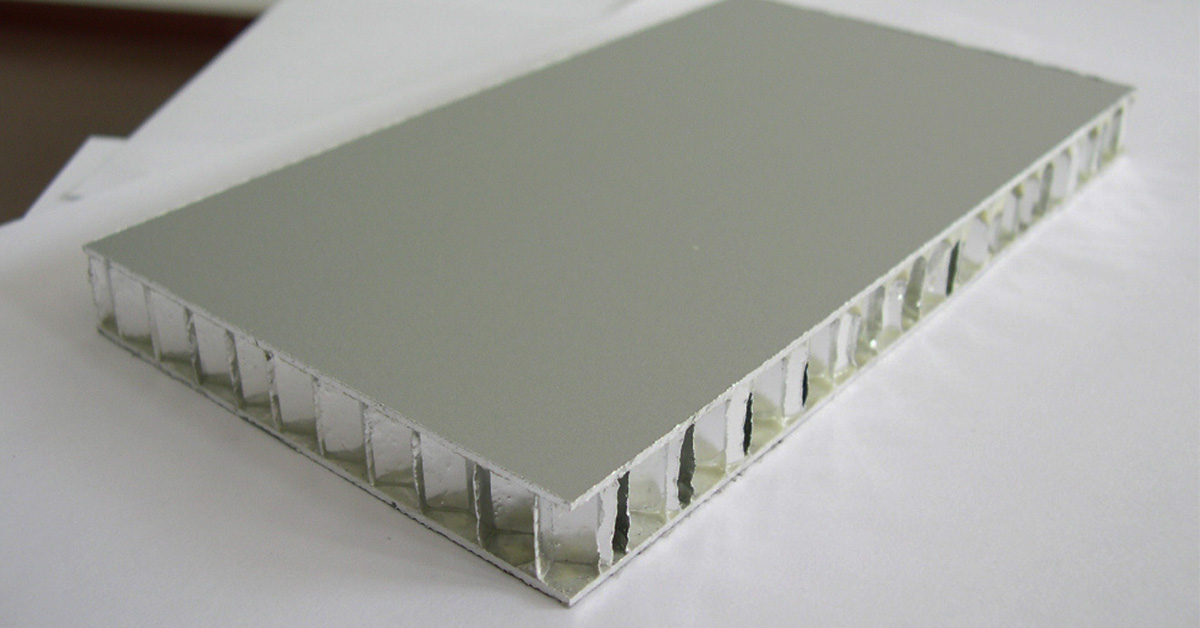
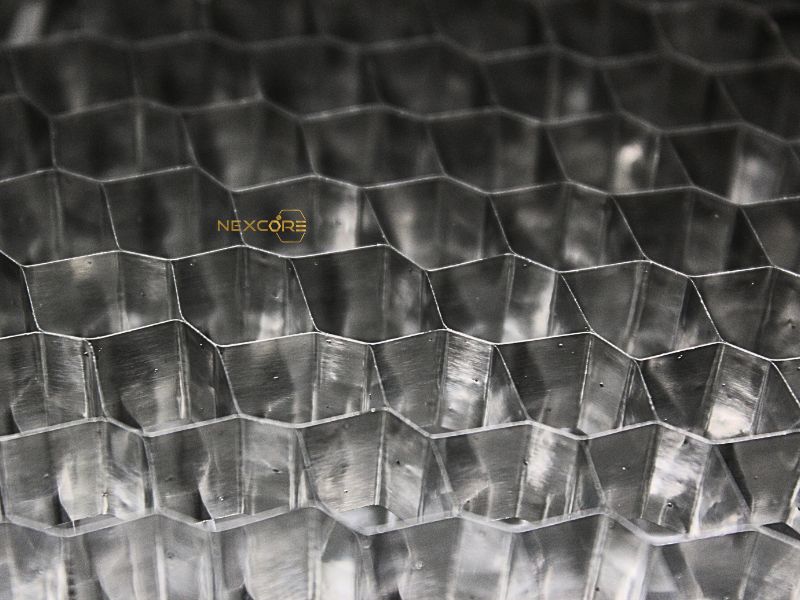
The honeycomb principle is not decorative. It is structural mathematics. Hexagonal cells behave like countless miniature I beams arranged in a continuous matrix. One skin of the sandwich panel handles compression. The opposite skin carries tension. And the NexCore honeycomb core absorbs shear forces while bracing both skins apart.
This separation of skins dramatically increases bending stiffness without increasing weight. You know what I mean. The further apart the skins, the greater the rigidity. And we achieve that without adding mass.
NexCore (Aluminium Honeycomb Core) Manufacturing Process
We manufacture NexCore using AA3003 alloy in H18 temper . This alloy temper combination delivers high strength with controlled ductility and corrosion resistance.
Step 1: Aluminium Foil Preparation
Foil thickness ranges from 0.040 mm to 0.090 mm depending on structural requirements.
Step 2: Adhesive Application and Precision Bonding
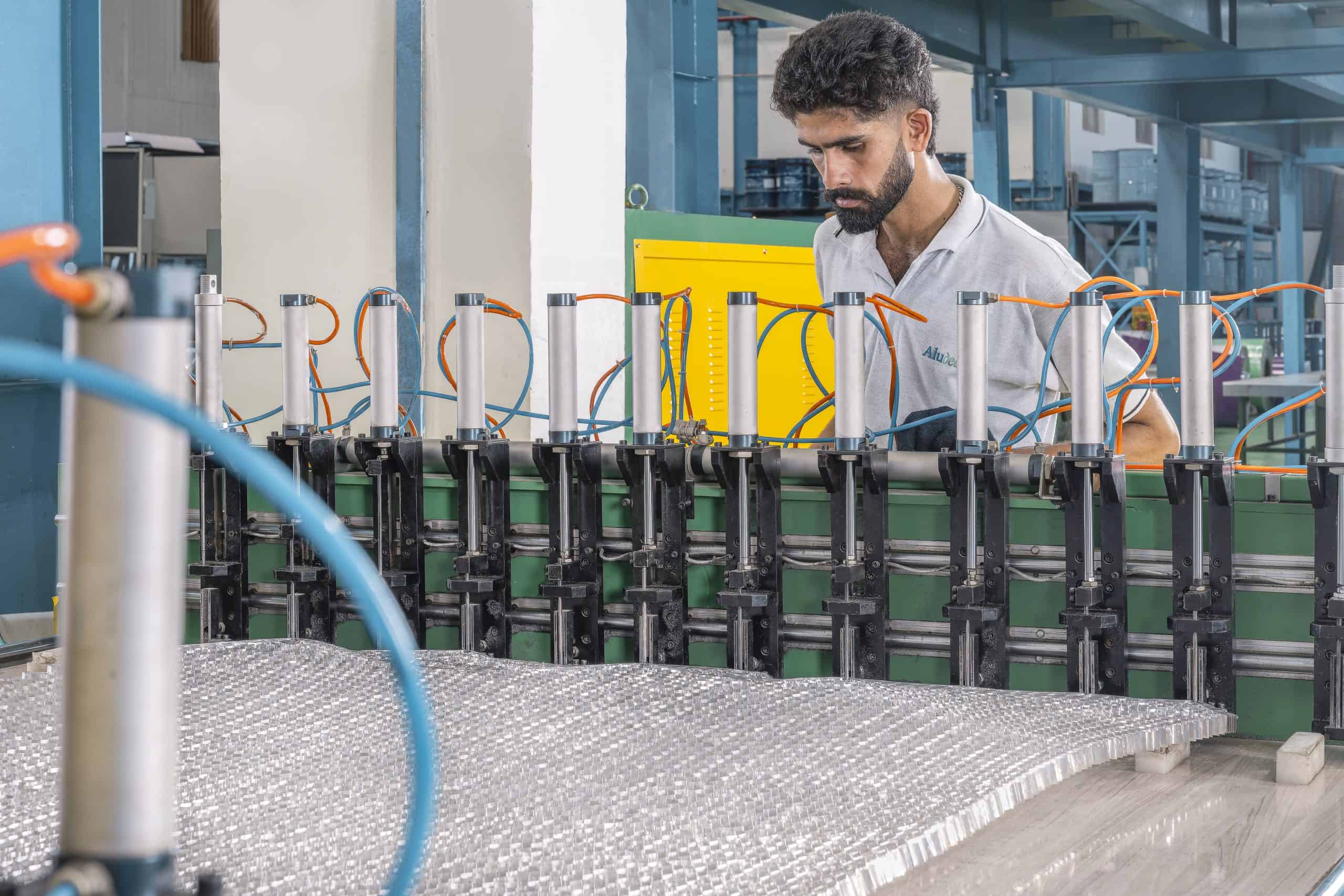
Using our fully automated roll forming and glue dispensing line , adhesive lines are applied with calibrated spacing that determines cell size accuracy. Bond integrity is critical. Poor bonding means shear failure. We do not leave that to chance.
Step 3: Controlled Expansion
After curing under heat and pressure, bonded stacks are expanded into hexagonal geometry. Cell sizes available include 3 mm, 4 mm, 6 mm, 10 mm, 14 mm and 19 mm . Smaller cells increase density and compressive strength. Larger cells optimize weight efficiency.
Step 4: Panel Assembly
Expanded NexCore is bonded between aluminium skins of thickness 0.5 mm to 1 mm depending on application . Panel thickness can range from 6 mm up to 100 mm . This is not outsourced. This is engineered internally. And that control is our differentiator.
Technical Specifications of Nexcomb Panels
Aluminium Skins
- Alloy grade: AA3105 or AA5005
- Temper: H14 or H24
- Tensile strength: 150 to 225 N per mm²
- Yield strength: Minimum 130 N per mm²
- Elongation: Minimum 2 percent
- Modulus of elasticity: 70000 N per mm²
Coefficient of linear thermal expansion stands at 2.36 × 10⁻⁵ mm per mm per °C , ensuring predictable thermal behavior in façade systems.
Coating Systems
We use continuous coil coating process with PVDF or FEVE systems.
- Two coat system: 25 to 28 microns
- Three coat system: 30 to 35 microns
- Pencil hardness: Minimum 2H
- Formability: 2T bend without cracking
Weatherometer testing extends to 4000 hours under AAMA 2605 compliance.
Structural Performance Testing
We do not rely on theoretical strength claims. Nexcomb panels undergo rigorous ASTM testing including:
- ASTM C297 for flatwise tensile strength
- ASTM C273 for shear properties
- ASTM C365 for flatwise compressive properties
- ASTM C393 for flexural properties
- ASTM D1781 climbing drum peel test
These are not marketing claims. These are measurable structural validations.
Fire Safety Performance
But strength alone is not enough in high rise applications. Nexcomb panels comply with EN 13501 1 classification of Class A2 s1 d0 .
This means:
- Limited combustibility
- No flaming droplets
- Negligible smoke emission
And that performance makes Nexcomb suitable for high rise structures and high risk occupancy zones. Let us be honest. Evaluating panels only on A1 solid sheet classification misses the performance intelligence of honeycomb sandwich systems.
Sustainability Metrics
Sustainability is not a slogan for us. It is calculated.
A 12 mm Nexcomb panel with 50 percent recycled aluminium skins and 30 micron PVDF coating registers approximately 4 to 7 kg CO2 equivalent per square meter .
Compare that with:
- 3 mm solid aluminium sheet: 9 to 11 kg CO2 equivalent per square meter
- 4 mm ACP panel: 10 to 13 kg CO2 equivalent per square meter
That is nearly half the embodied carbon in some cases.
Panels are 100 percent recyclable and contain 30 percent recycled aluminium content. Lower dead load reduces substructure steel requirement. Reduced steel means reduced project carbon footprint. The impact compounds.
Nexcomb 3D Louvers and Parametric Facades
Flat cladding is predictable. Parametric façades are intelligent.
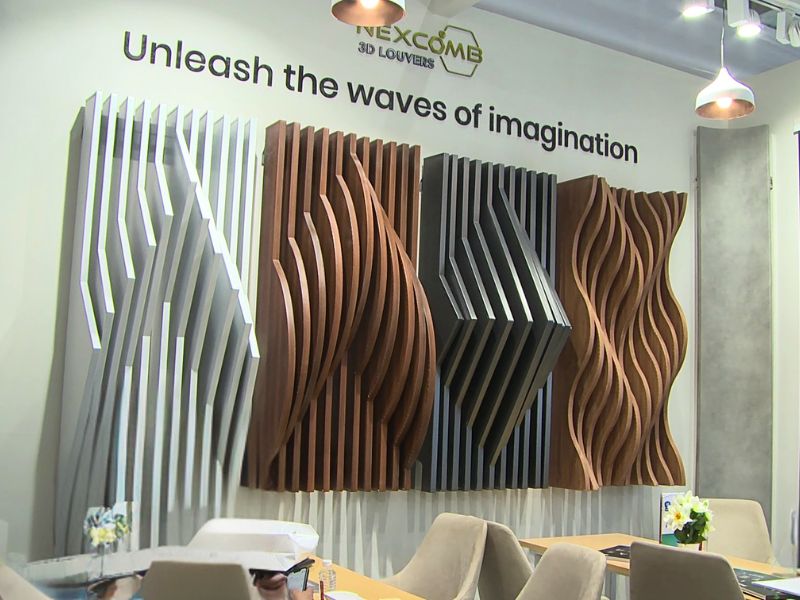
Nexcomb 3D louvers are engineered using aluminium honeycomb panels arranged as diagonal or layered fins . These fins:
- Control direct solar radiation
- Reduce heat gain
- Improve daylight diffusion
- Reduce structural load due to lightweight honeycomb core
Thermal performance improves due to shading geometry. Acoustic performance reaches up to 25 to 30 dB sound reduction. Working temperature range spans from minus 20°C to plus 80°C , ensuring durability across climatic extremes. And unlike conventional louvers that act as add on elements, Nexcomb parametric fins integrate structurally with curtain wall and rainscreen systems .
Installation Systems Developed in House
We have indigenously developed ready to use fixing systems:
- Uni Lock
- M Lock
- Edge Lock
- Zenith Lock
- Interlock
Cassette and non cassette panels use Uni Lock. J type panels use M Lock and Edge Lock. Ceiling installations use Zenith Lock. Factory finished, ready to fix panels minimize on site errors. No special heavy installation teams required in most façade cases.
Comparative Structural Advantage
A 10 mm Nexcomb panel with 0.7 mm aluminium skins and 10 mm cell size weighs approximately 5.2 kg per square meter. Solid metal sheets at 3 mm thickness exceed 8.2 kg per square meter. Stone panels exceed 10 kg per square meter .
Lower weight means:
- Reduced dead load
- Reduced anchoring demand
- Faster installation
- Better seismic performance
And greater structural efficiency.
Applications
We deploy Nexcomb across:
- High rise façades
- Cleanrooms
- Ceilings
- Mobility sector interiors
- Airports and metro stations
- Corporate buildings and retail spaces
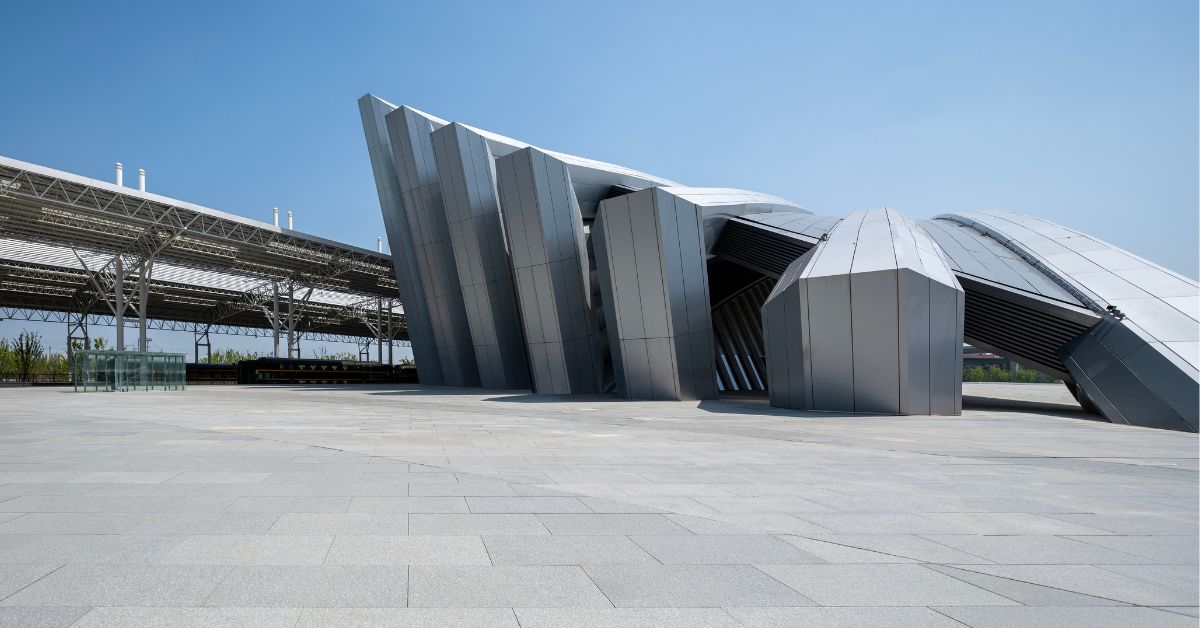
Stone veneers bonded to Nexcomb reduce weight by up to 80 percent while increasing strength significantly. Integration with ACP, glass and metal louvers allows architectural coherence without structural compromise .
What makes Nexcomb aluminium honeycomb panels structurally stronger than solid aluminium sheets?
Nexcomb aluminium honeycomb panels are stronger because they use a honeycomb sandwich construction rather than relying on material thickness alone. The aluminium honeycomb core acts like thousands of miniature I beams, separating the top and bottom skins to increase bending stiffness and load distribution. This dramatically improves strength to weight ratio compared to solid sheets. For example, a 10 mm Nexcomb panel weighs about 5.2 kg per sqm
yet offers superior rigidity. As an aluminium honeycomb panel manufacturer in India with in house core production, we ensure precision bonding and consistent performance across all honeycomb boards without unnecessarily increasing honeycomb sheet price.Is Nexcomb suitable for high rise and fire compliant facade applications?
Yes. Our aluminium honeycomb panels are engineered for high rise facades where structural strength and fire safety are non-negotiable. Nexcomb complies with EN 13501 1 Class A2 s1 d0 classification, meaning the panels are non-combustible, produce no flaming droplets and emit negligible smoke. The aluminium honeycomb core enhances stability while keeping weight low, reducing structural load on tall buildings. As an aluminium honeycomb panel manufacturer in India with in house core production, we ensure precision bonding and consistent quality. Compared to conventional honeycomb boards or solid sheets, Nexcomb offers better strength to weight efficiency without inflating overall honeycomb sheet price.
Can Nexcomb aluminium honeycomb panels be customized for curved or complex designs?
Absolutely. Our aluminium honeycomb panels are available in thicknesses from 6 mm to 100 mm
and can be curved within radii of 300 mm to 2000 mm, enabling complex facades and parametric geometries. The aluminium honeycomb core allows panels to remain lightweight yet rigid, which is critical for large format and curved installations. Whether used as façade cladding, ceilings or advanced honeycomb boards for design driven structures, customization is seamless. As a leading aluminium honeycomb panel manufacturer, we fabricate panels with high dimensional accuracy, helping architects optimize performance without excessive material cost or unpredictable aluminium honeycomb sheet price fluctuations.How sustainable are Nexcomb aluminium honeycomb panels compared to solid sheets?
Sustainability is built into the structure of our aluminium honeycomb panels. A 12 mm panel registers approximately 4 to 7 kg CO2 equivalent per sqm, significantly lower than comparable solid aluminium sheets. The aluminium honeycomb core uses minimal material to deliver maximum stiffness, reducing raw material demand and transport load. These honeycomb boards are fully recyclable and contain recycled aluminium content, aligning with green building certifications. As an aluminium honeycomb panel manufacturer in India with integrated production, we maintain efficiency from core to coating. This ensures long term value without disproportionately increasing honeycomb sheet price for sustainable projects.
What quality tests validate Nexcomb aluminium honeycomb panels?
Our aluminium honeycomb panels are tested under internationally recognized ASTM standards
including C393 for flexural strength, C297 for flatwise tensile strength and C273 for shear properties of the aluminium honeycomb core. Coating performance meets AAMA 2604 and 2605 standards, ensuring durability under harsh environmental exposure. These validations confirm structural integrity, bonding strength and weather resistance across applications. As a top aluminium honeycomb panel manufacturer in India, we control the entire process in house, delivering honeycomb boards with consistent performance while maintaining competitive honeycomb sheet price benchmarks in the market.